The Gospel According to the Older Testament
Alongside the "Roman Road" of the New Testament
Christianity, especially the claim in John 14:6 where Jesus says, "I am the way, the truth, and the life," is often viewed as narrow or exclusive. Yet through Jesus, the way has been opened for all people to enter God's Kingdom, both Jew and Gentile.
Jesus and the apostles taught from the Old Testament. That was their Bible. They had no other. The writings of the New Testament build upon and illuminate what was already revealed. When we read the New Testament, we must learn to see with "Jewish eyes," continually asking, "Where is this found in the Old Testament?"
The "good news," or gospel message, is not a new idea. It was God's plan from the very beginning. In Genesis 3:15, we see the first glimpse of this promise: "He will crush your head, and you will strike His heel." This points forward to Jesus' victory over sin and Satan.
Jesus' declaration that He is the Way, the Truth, and the Life aligns perfectly with the first commandment: "You shall have no other gods before Me" (Exodus 20:3). Why would God make such an exclusive claim? Because He alone is the one true God, the only One who can truly save and help us. In this light, the commandments are not merely rules, but holy promises that reveal God's love and His desire for our good.
Now, let us consider an evangelistic tool known as the Roman Road from the New Testament (below, right), and compare it with what the Old Testament (below, left) reveals about our sin and God's plan of salvation for humanity.
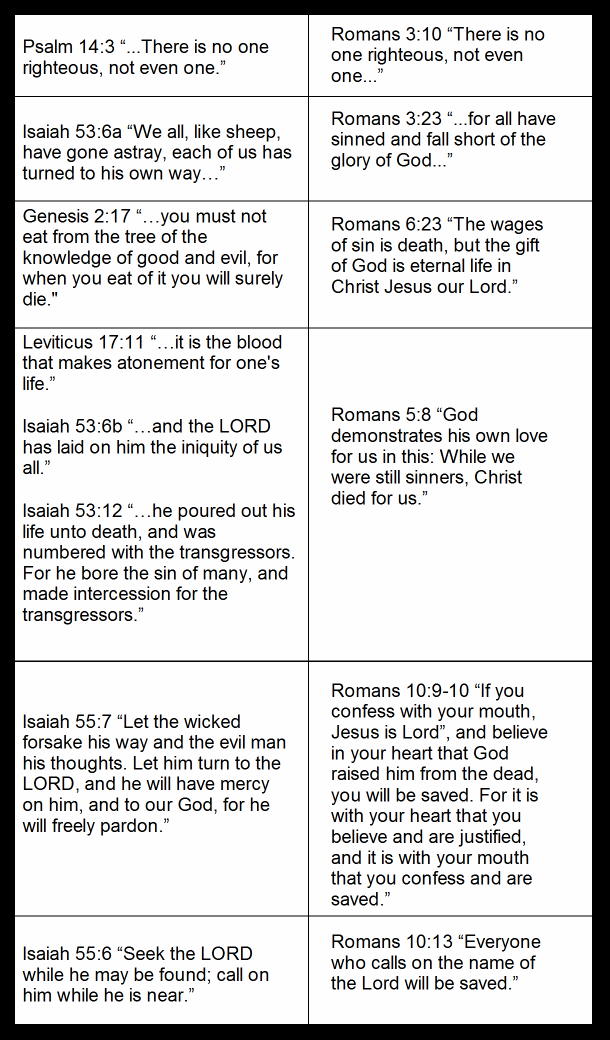
These verses show us that our good works are not enough. No one is righteous. In fact, Isaiah 64:6 tells us that even our righteous acts are like filthy rags.
We cannot be forgiven of our sins without a sacrifice. Leviticus teaches that it is the blood that makes atonement for one's life, and this truth is echoed in Hebrews 9:22: ". . . without the shedding of blood there is no forgiveness."
We need atonement, that is, "at-one-ment" with God. We need to be made right with Him. Our sin debt requires payment. It must be satisfied either by our own death or by the death of a substitute, someone to take our place. His name is Jesus, for "He will save His people from their sins" (Matthew 1:21).
Our sin problem requires divine intervention. The prophet Isaiah declared, ". . . He bore the sin of many and made intercession for the transgressors." The apostle Paul wrote in Romans, ". . . while we were still sinners, Christ died for us." God provided the solution even before we committed our first sin.
This gospel message, this good news, is for all who call on Him and trust in Jesus' atoning work on the cross. Those who are forgiven are then commanded to go and tell others: "Go into all the world and preach the good news to all creation" (Mark 16:15). This echoes Isaiah 52:7: "How beautiful on the mountains are the feet of those who bring good news, who proclaim peace, who bring good tidings, who proclaim salvation."
From Genesis to Revelation, the message of the Bible is one unified story of redemption. It is an inclusive message of God's love and salvation for all people.
Prayer: "Father God, Help me to proclaim your good news today. Help me to be a peacemaker, holding out the Word of Truth to those I
encounter. Amen."
Copyright 2009 S.A. Keith - All Rights Reserved.
You can make a
difference!
Your donation
to the site helps to distribute
our ministry resources to churches across the world.
Subscribe to our Newsletter - Learn More